10 articles
Articles
Long-form writing on what the record can and cannot tell you. Every number in an article names where it came from, or the article does not publish.
Last updated
10 articles
-
Research
Yuviwel (Navepegritide): The Peptide Therapy That's Rewriting What's Possible in Dwarfism
On 27 February 2026 the U.S. Food and Drug Administration approved Yuviwel (navepegritide), a once-weekly injection for children with achondroplasia. It delivers a signal the human body already makes and destroys within minutes, and makes it last seven days. That is a problem peptide chemistry has been circling for decades, and this is what solving it looks like.
-
Research
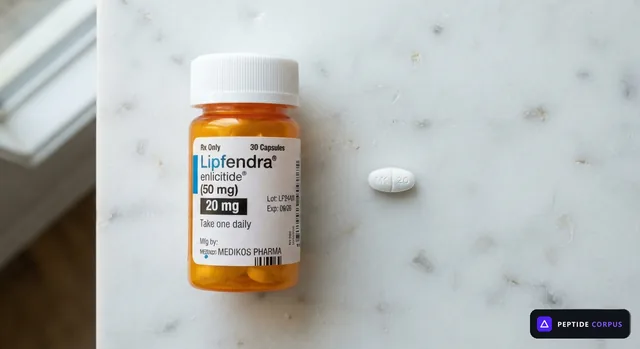
Lipfendra (Enlicitide): The First-Ever Daily Oral PCSK9 Inhibitor for High Cholesterol
In July 2026 the U.S. Food and Drug Administration approved Lipfendra (enlicitide), a daily oral pill and the first oral therapy in the PCSK9 inhibitor class. It is also a macrocyclic peptide — a molecule of the kind the gut is built to destroy — taken by mouth, which is the part of this approval that will still matter in twenty years.
-
Research
Why NAD+ Levels Decline with Age and How to Replenish Them
As we age, our bodies undergo countless microscopic changes that gradually erode the vitality we once took for granted. Among the most significant of these changes is the steady decline of a critical molecule called NAD+ (nicotinamide adenine dinucleotide). This coenzyme, found in every cell of your body, is essential for energy production, DNA repair, and maintaining the cellular functions that keep you feeling young and vibrant.
-
Research
The Copper Peptide That Restores Youthful Tissue Function
Among the most promising compounds in the field of anti-aging research is GHK-Cu, a naturally occurring copper peptide with remarkable regenerative properties. Found in human plasma, saliva, and urine, this tripeptide—composed of the amino acids glycine, histidine, and lysine—plays a fundamental role in tissue repair, collagen production, and overall cellular health. However, like NAD+, GHK-Cu levels decline significantly with age, contributing to the gradual loss of regenerative capacity that characterizes aging tissues.
-
Basics
Where research peptides come from
Three completely different regulatory positions arrive in near-identical vials. Learn to tell them apart upstream, because the label is the last place that will tell you.
-
Protocols
What cycling schedules rest on
Everyone quotes the same on-and-off intervals and no trial has ever tested one. Here is what the desensitisation evidence really shows, and the stopping rule that does exist.
-
Protocols
Travelling with a protocol
Two agencies, two entirely different questions, and almost every guide on the internet answers one and reports it as the other. Sort that out and travelling gets a great deal simpler.
-
Safety
Reading a certificate of analysis
Everyone asks for a COA. Almost nobody has been told what one is. Learn to read the four lines on it and you can see straight through most of this market.
-
Safety
Peptides and drug testing
A workplace panel and an anti-doping laboratory ask unrelated questions with unrelated instruments. Follow the detection numbers back and nearly all of them lead to one nasal study on single volunteers.
-
Basics
Peptides from bench to biohack
A dozen amino acids in the right order can tell a cell to build a blood vessel. That is the appeal. What the approved ones actually do, what the research ones have not shown yet, and where the line between them falls.






No article matches that.