Lipfendra (Enlicitide): The First-Ever Daily Oral PCSK9 Inhibitor for High Cholesterol
In July 2026 the U.S. Food and Drug Administration approved Lipfendra (enlicitide), a daily oral pill and the first oral therapy in the PCSK9 inhibitor class. It is also a macrocyclic peptide — a molecule of the kind the gut is built to destroy — taken by mouth, which is the part of this approval that will still matter in twenty years.
Last updated
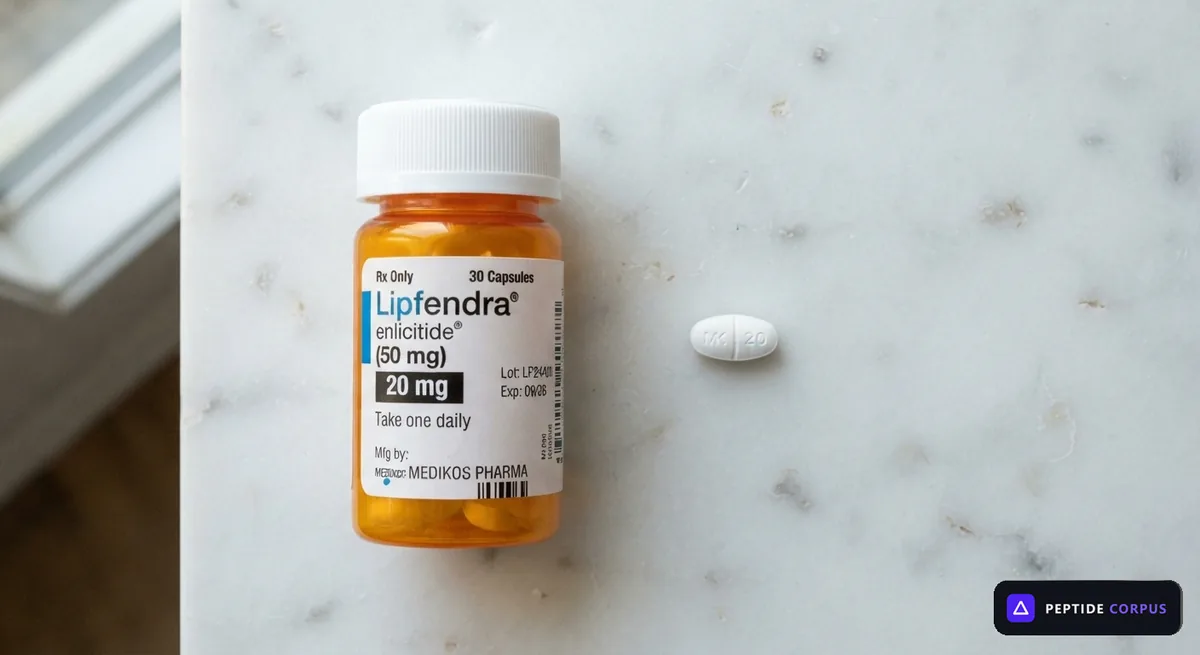
What Lipfendra Is
Enlicitide is a macrocyclic peptide, sold under the brand name Lipfendra, and it belongs to a class of drugs that until now had only ever been given by injection. PCSK9 inhibitors block a protein that governs how much low-density lipoprotein cholesterol the liver can clear out of the blood. Blocking it lets the liver pull more LDL out of circulation, and LDL is the cholesterol that builds up in artery walls and raises the risk of heart attack and stroke.
The label covers adults with high cholesterol, and adults with an inherited form of it called heterozygous familial hypercholesterolaemia, who need further LDL reduction alongside diet and exercise. What makes the approval notable is not a new mechanism. It is the same mechanism, in a form somebody can swallow with a glass of water.
What the label says it is
An oral PCSK9 (proprotein convertase subtilisin/kexin type 9) inhibitor that lowers LDL cholesterol.
- Drug name: enlicitide. Brand name: Lipfendra
- One 20 mg tablet, once daily, by mouth
- Novel macrocyclic peptide technology is what gets the effect into oral form
Who it is for
Adults who need additional LDL reduction on top of diet, exercise and whatever they are already taking.
- Adults with hypercholesterolaemia
- Adults with heterozygous familial hypercholesterolaemia (HeFH)
- In the trials, every participant was already on maximally tolerated statin therapy
How It Works
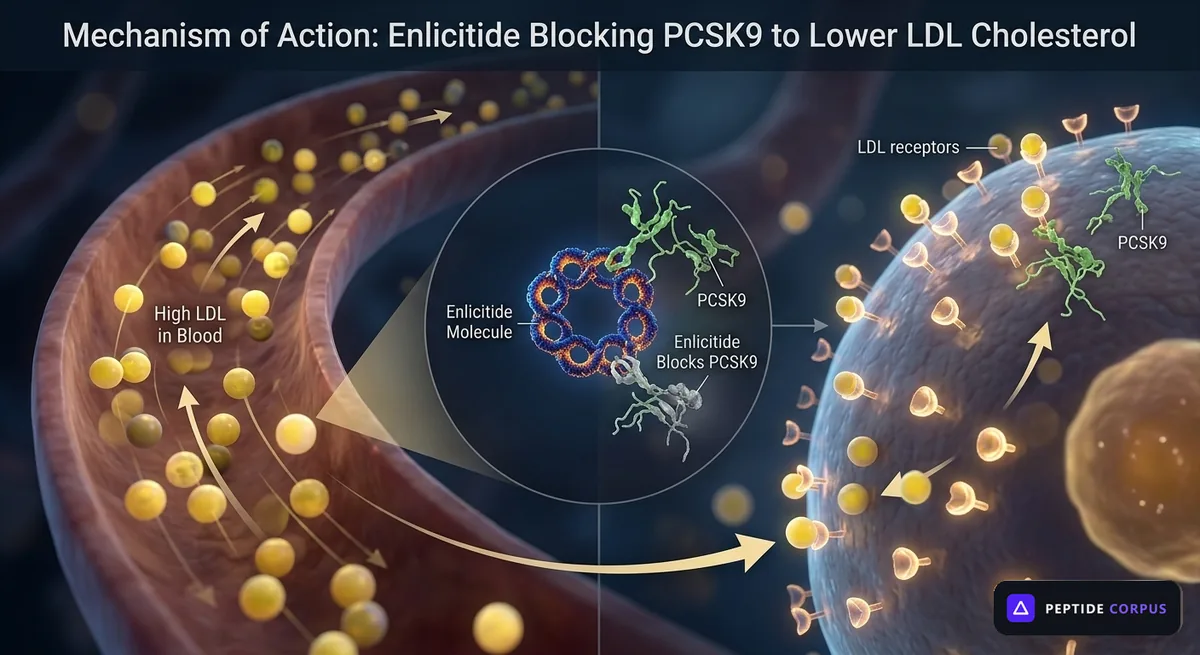
PCSK9 is a protein that finds LDL receptors on liver cells and marks them for destruction. Fewer receptors means less LDL pulled out of the blood, and more of it left circulating. Enlicitide binds to PCSK9 and blocks it, so those receptors survive, keep working, and go on clearing LDL from the bloodstream.
That is the same target the injectable PCSK9 inhibitors hit. The difference is chemistry rather than biology: a macrocyclic peptide is a ring, and the ring is what lets a peptide survive the gut and reach the bloodstream intact, which is what the injectable versions of this class could not do.
This Is a Peptide, and That Is the Achievement
Enlicitide is not a small molecule. It is a macrocyclic peptide — a chain of amino acids joined head to tail into a ring — and that single fact makes this approval a landmark in chemistry as much as in cardiology.
Peptides are not supposed to be able to do this. Swallow one and the stomach's acid and the gut's proteases treat it as food, because that is exactly what it looks like to them. Whatever survives digestion then has to cross the intestinal wall, and peptides are generally too large and too water-loving to get through. That is why this entire drug class has been injected: not because anyone preferred needles, but because the molecules that block PCSK9 well are the molecules the gut destroys.
Macrocyclisation is what changes the odds. Closing the chain into a ring removes the loose ends proteases grab first, locks the molecule into one shape rather than letting it flop between thousands, and tucks away the polar groups that would otherwise stop it crossing a membrane. The result is a peptide with a small molecule's manners and a biologic's grip on its target.
The manufacturing is the part that rarely reaches a press release and deserves to. Merck's published route reaches the finished molecule in 43 steps, with the longest linear sequence cut to 21, and improves yield by roughly a factor of a thousand over the first-generation synthesis. A drug nobody can make at scale is a paper rather than a medicine, and that thousandfold is the distance between the two.
-
A ring, not a chain
Head-to-tail cyclisation removes the free ends digestive enzymes attack first, which is what lets the molecule reach the bloodstream intact rather than being read as protein and taken apart.
-
A biologic's grip, taken orally
PCSK9 is blocked across a broad protein-to-protein interface, which is why antibodies were reached for first. A macrocycle is large enough to cover that surface and still small enough to be absorbed.
-
Made at scale
43 steps, longest linear sequence 21, yield up roughly a thousandfold on the first-generation route. Scale is what turns a synthesis into a supply.
What the Trials Measured
Two phase 3 trials, run under the CORALreef programme, enrolled 3,207 adults with severe hypercholesterolaemia who were already taking maximally tolerated statin therapy. Both compared enlicitide against placebo on top of that background treatment.
In CORALreef Lipids, which enrolled patients with atherosclerotic cardiovascular disease or at high risk of it, Lipfendra produced a 56% reduction in LDL cholesterol at 24 weeks compared with placebo. In CORALreef HeFH, in patients with the inherited form, the reduction was 59%. Across the programme, the figure quoted is up to 60% LDL lowering on top of high-intensity statins and other background therapies.
That last phrase is the part worth pausing on. These are not reductions against nothing. They are reductions on top of the treatment those patients were already getting, which is the situation the drug is actually prescribed into.
-
Powerful LDL reduction
56% at 24 weeks in CORALreef Lipids, 59% in CORALreef HeFH, both against placebo and both on top of maximally tolerated statin therapy.
-
No needles
The cholesterol-lowering power of the older injectable PCSK9 inhibitors, without the self-injections — which matters for patients uncomfortable with needles and for prescribers who have been slow to reach for the injectable versions.
-
Complements statins
It can be taken alongside a statin, or used as an alternative for someone who cannot tolerate one. In the trials it was always an addition, never a replacement.
How the Label Says to Take It
One 20 mg tablet, once daily, in the morning on an empty stomach. Swallow it whole — do not split, crush or chew it. Take it with water, black coffee or plain tea, and nothing else.
Then wait. The label asks for at least 30 minutes after the tablet before eating, or before drinking anything other than water, black coffee or plain tea. Store the bottle at room temperature, 68°F to 77°F (20°C to 25°C), in the original bottle with the lid tightly closed. There is a moisture absorber in the bottle, and it stays there.

Taking it
One 20 mg tablet once daily, in the morning, on an empty stomach.
- Swallow whole — do not split, crush or chew
- Water, black coffee or plain tea only
- Wait at least 30 minutes before eating or drinking anything else
Storing it
Room temperature, 68°F to 77°F (20°C to 25°C), in the bottle it came in.
- Keep the lid tightly closed
- The bottle contains a moisture absorber — do not remove it
- Keep the tablets in the original bottle rather than a pill organiser
Side Effects on the Label
Most people experience no side effects. In the first trial, the frequency of adverse reactions was similar between the enlicitide group and the placebo group.
In the HeFH trial, two side effects occurred more often with Lipfendra than with placebo: dizziness, in 9% of the Lipfendra group against 4% on placebo, and diarrhoea, in 7% against 2%. In both trials, similar proportions of patients in each group stopped treatment because of side effects.
Seek medical help right away for symptoms of a serious allergic reaction — swelling of the face or throat, trouble breathing, or hives.
More common than on placebo
The two reactions the HeFH trial recorded more often in the treated group than in the placebo group.
- Dizziness: 9% on Lipfendra, 4% on placebo
- Diarrhoea: 7% on Lipfendra, 2% on placebo
What the comparison does not show
Two trials over the reported follow-up periods, in adults already on maximally tolerated statins.
- Discontinuation for side effects was similar between the groups
- Long-term outcome data continues to accrue in the CORALreef programme
- A rate measured against placebo is not the same as a rate in ordinary use
Why This Matters
Cardiovascular disease remains the leading cause of death in the United States, and elevated LDL cholesterol is one of its most important modifiable risk factors. High cholesterol usually causes no symptoms at all, so a great many people do not know they have it until a routine blood test says so.
The case for calling this a major moment does not rest on the size of the LDL reduction. Injectable PCSK9 inhibitors have delivered reductions of this order for years, and the class has still not moved population-level outcomes the way its potency suggested it should. The gap between what a drug does in a trial and what it does in a population is almost never pharmacology. It is whether people take it.
That is where a tablet earns its place. A fortnightly injection requires a prescription, a pharmacy that stocks it, a fridge, a technique somebody has to be taught, and a decision to repeat all of it twice a month for the rest of a life. Every one of those is a place to fall out of treatment, and people do — which is part of why prescribers have been slow to reach for the injectables even where they are plainly indicated. A drug somebody will actually take every morning does more work than a better drug somebody stops collecting.
The longevity argument follows from arithmetic rather than from optimism. LDL is not merely a marker of atherosclerosis, it is a cause of it, and risk tracks cumulative lifetime exposure — how much LDL has passed through an artery wall, over how many years. Lowering it earlier and for longer is therefore worth more than lowering it harder and later. A daily oral option is the first version of this class that somebody in their forties with an inherited risk might realistically stay on for decades, and decades is the unit that matters.
What none of that establishes is that anyone lives longer. CORALreef Outcomes is the trial that asks the question directly — major adverse cardiovascular events as the primary endpoint, roughly six years of follow-up, inside a programme enrolling around 17,000 patients — and it has not reported. Until it does, what is on file is a drug that lowers a causal risk factor a great deal, in a form people are more likely to keep taking, and a hypothesis about what that will be worth.
One thing this drug is not, and the confusion is common enough to be worth stating plainly: it is not a blood pressure treatment. PCSK9 has no established relationship with blood pressure, plasma levels of it do not track with blood pressure in people who have hypertension, and neither the label nor the CORALreef results claim an effect on it. Cholesterol and blood pressure are two separate risks that happen to share a specialty and a waiting room. This addresses one of them.
Glossary
The terms this article uses, defined once.
- Atherosclerotic cardiovascular disease (ASCVD)
- A condition where plaque builds up inside arteries, narrowing them and restricting blood flow, which can lead to heart attack or stroke.
- CORALreef trials
- The phase 3 clinical trials — CORALreef Lipids and CORALreef HeFH — that evaluated the efficacy and safety of enlicitide.
- HeFH (heterozygous familial hypercholesterolaemia)
- An inherited condition affecting how the body removes cholesterol from the blood, leading to very high LDL levels from birth.
- Hypercholesterolaemia
- Too much LDL cholesterol in the blood.
- LDL cholesterol
- Low-density lipoprotein cholesterol — often called bad cholesterol, because excess amounts build up in artery walls.
- Lipid panel
- A blood test that measures cholesterol and triglyceride levels.
- MACE (major adverse cardiovascular events)
- The composite endpoint cardiovascular outcome trials are judged on, typically combining cardiovascular death, heart attack and stroke. It is the endpoint of CORALreef Outcomes, which has not reported.
- Macrocyclic peptide
- A peptide whose amino acid chain is closed into a ring. The ring removes the loose ends digestive enzymes attack first and holds the molecule in a single shape, which is what allows some macrocycles to be swallowed rather than injected. Enlicitide is one.
- Oral bioavailability
- The fraction of a swallowed dose that reaches the bloodstream intact. For most peptides it is close to zero, which is the problem macrocyclisation is solving here.
- PCSK9
- Proprotein convertase subtilisin/kexin type 9 — a protein that regulates LDL cholesterol levels in the blood by marking LDL receptors for destruction.
- PCSK9 inhibitor
- A class of drugs that block the PCSK9 protein, allowing the liver to remove more LDL cholesterol from the blood.
- Placebo
- An inactive substance used in clinical trials as a comparison to the active drug.
- Statin
- A common class of cholesterol-lowering medications that reduce the liver's production of cholesterol.
Sources and evidence
Sources and evidence
10 sourcesFDA Approves First Oral Therapy that Inhibits Proprotein Convertase Subtilisin/Kexin Type 9 (PCSK9) to Lower Bad Cholesterol in Adults with High Cholesterol. U.S. Food and Drug Administration, 16 July 2026Regulatory
How this source supports the article
That the approval happened, on that date, and that enlicitide is the first oral therapy in the PCSK9 inhibitor class. It is also the source for the approved population.
Limitations
A regulatory announcement states what was approved and for whom. It is not the trial report, and it does not give the full efficacy or safety tables.
FDA Approves First Oral PCSK9 Inhibitor to Lower LDL Cholesterol in Adults with High Cholesterol. U.S. Food and Drug Administration, 16 July 2026Regulatory
How this source supports the article
The press announcement of the same approval, and the framing of enlicitide as the first oral drug in this class.
Limitations
The same limits as the drug-centre announcement above: it reports the decision rather than the evidence behind it.
Enlicitide's FDA Approval for LDL-C Reduction and the CORALreef Outcomes Trial. HCPLive, 22 July 2026Trade press
How this source supports the article
The CORALreef programme figures quoted here — the 56% reduction in CORALreef Lipids at 24 weeks, the 59% in CORALreef HeFH, and the 3,207 adults enrolled on maximally tolerated statin therapy.
Limitations
Trade press reporting of trial results, not the peer-reviewed publication. The cardiovascular outcomes arm of the programme is ongoing, so these are lipid endpoints rather than event endpoints.
Newly approved pill cuts LDL cholesterol levels by more than half. Harvard Health Publishing, 20 July 2026Editorial
How this source supports the article
The clinical context: why an oral option matters for access, and why prescriber hesitancy over injectables has held the class back.
Limitations
A general-audience commentary. It interprets the approval rather than reporting new data.
FDA Approves Enlicitide, the First Oral PCSK9 Inhibitor for High Cholesterol. Pharmacy Times, 16 July 2026Trade press
How this source supports the article
The macrocyclic peptide description, and the pharmacy-side account of the dosing and administration requirements.
Limitations
Trade press summary of the label and the approval, not a primary source for either.
LIPFENDRA (enlicitide) tablets, for oral use — Prescribing Information. DailyMed, 15 July 2026Label
How this source supports the article
Everything in the How the Label Says to Take It and Side Effects sections: the 20 mg once-daily dose, the empty-stomach and 30-minute rules, the permitted drinks, the storage range and the moisture absorber, and the dizziness and diarrhoea rates against placebo.
Limitations
A label states what was approved and what the trials recorded. It is not a guide to whether this drug is right for any particular person, and it does not compare enlicitide against the injectable PCSK9 inhibitors.
Lipfendra (Enlicitide): Uses, Side Effects, Interactions, Pictures, Warnings and Dosing. WebMD, 17 July 2026Consumer reference
How this source supports the article
The consumer-facing restatement of the dosing and administration instructions, and the allergic-reaction symptoms to act on.
Limitations
A secondary consumer summary of the label. Where it differs from the prescribing information, the prescribing information is the record.
Enlicitide, a Novel Oral Macrocyclic Peptide PCSK9 Inhibitor for Lipid Lowering: A Systematic Review and Meta-Analysis. Journal of Cardiovascular Development and DiseaseSystematic review
How this source supports the article
That enlicitide is a macrocyclic peptide, and the pooled lipid-lowering effect across the trials that have reported.
Limitations
A meta-analysis inherits the limits of what it pools. None of the included trials measured cardiovascular events, so it cannot speak to outcomes.
Enlicitide Decanoate Cardiovascular Outcomes Study (MK-0616-015), CORALreef Outcomes. ClinicalTrials.gov, NCT06008756Trial registration
How this source supports the article
That the outcomes question is being asked, what its primary endpoint is, and that follow-up runs to approximately six years.
Limitations
A registration is a statement of intent. It carries no results, and this trial has reported none.
Enlicitide Decanoate. American Peptide SocietyChemistry
How this source supports the article
The synthesis figures: 43 steps, a longest linear sequence of 21, and the roughly thousandfold yield improvement over the first-generation route.
Limitations
A synthesis summary describes how the molecule is made. It says nothing about how it performs in a patient.